
Fairness, efficiency, and sustainability of agri-food value chains: reflections from the PRIN-AGREF final event
Written by: Tarek Allali
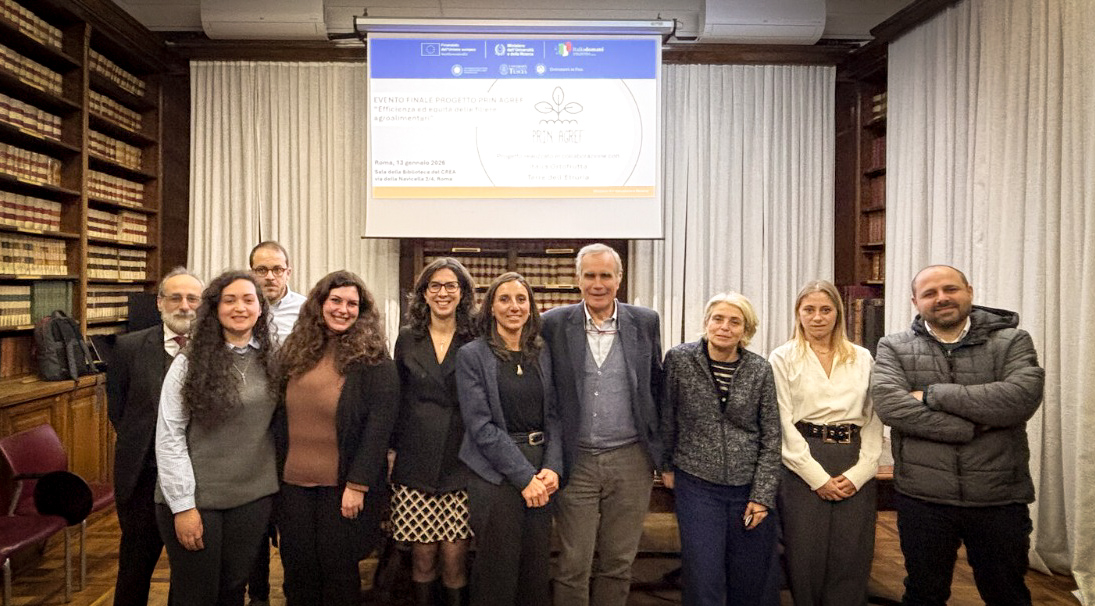
On 13th January 2026, the final event of the PRIN AGREF project (Agri-food value chains efficiency and fairness) was held in Rome at the Biblioteca of CREA. The event brought together researchers, producer organisations, market actors, and institutions to reflect on one of the most persistent challenges in agri-food systems: Unfair Trading Practices (UTPs) in the fruit and vegetable sector.
PRIN AGREF is a collaborative research project involving Università della Tuscia, Università di Cassino e del Lazio Meridionale, and Università di Pisa. Over more than two years of work, the project has aimed to move beyond abstract legal definitions of unfairness, developing empirical and analytical tools capable of capturing how UTPs operate in practice and how they affect producers, value chains, and public goods.
The event opened with a presentation of the project structure and objectives, followed by a discussion of how unfair trading practices can be identified in the fruit and vegetable sector. In this context, Prof. Francesca Galli recalled and contextualised the results of a focus group exercise carried out during the previous year, involving producer organisations and conducted in partnership with Italia Ortofrutta and Terre dell’Etruria. Her contribution illustrated how producers perceive and experience unfair practices in day-to-day commercial relations, and how these qualitative insights were translated into a structured framework of occurrence and impact indicators, spanning economic, social, and environmental dimensions.
Subsequent presentations addressed the legal framing of UTPs and their implications for value-chain governance, highlighting the limits of purely contract-based approaches and the role of power asymmetries between buyers and producer organisations. These contributions set the stage for a broader discussion on enforcement challenges and policy coherence, which was further enriched by two round tables involving researchers, market actors, and institutional representatives. The intervention of the EU Parliament Member Mr. Salvatore De Meo connected the project’s findings to the ongoing European debate on the implementation and possible revision of UTP legislation.
The final presentation of the event, delivered by Tarek Allali, brought the discussion back to empirical evidence from the field. Focusing on a case study in the artichoke value chain, his analysis examined product returns as a specific form of unfair trading practice, presenting the outcomes of contractual analysis, Life Cycle Assessment (LCA), and socio-economic impact. The presentation showed how unfair return practices not only shift economic risk onto producers, but also generate additional environmental burdens through extra transport, handling, and waste. This contribution highlighted how UTPs extend well beyond contractual unfairness, affecting the environmental performance and overall sustainability of agri-food systems.
The PRIN AGREF final event made one point unmistakably clear: unfair trading practices are not marginal anomalies but structural features of many agri-food value chains. Addressing these issues is essential not only to protect producers, but also to improve efficiency, environmental performance, and long-term sustainability. By combining empirical evidence, methodological innovation, and sustained engagement with stakeholders, PRIN AGREF offers concrete tools to support fairer and more transparent agri-food systems.
