Rural Innovation Ecosystems and Agricultural Transition: new perspectives on rural transformation
How do rural innovation ecosystems emerge and evolve? What makes some connections between farmers, researchers, businesses, institutions and communities generate new opportunities, while others struggle to produce lasting change? How does digitalisation interact with agricultural and rural transitions? And what forms of governance, intermediation and collaboration can support these processes?
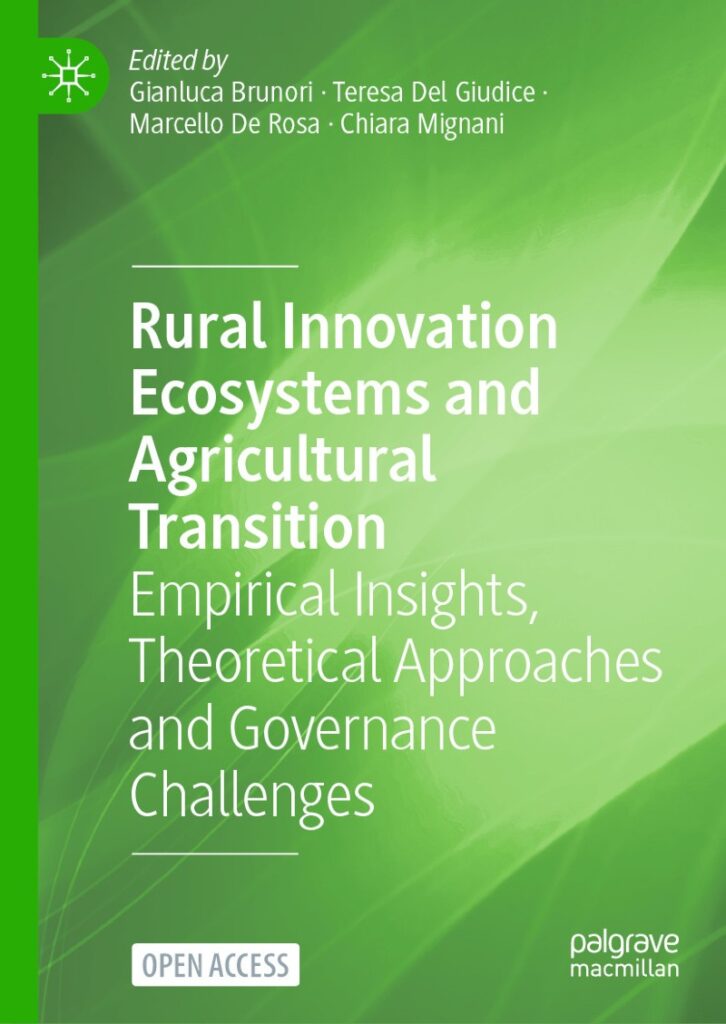
These are some of the questions explored in Rural Innovation Ecosystems and Agricultural Transition: Empirical Insights, Theoretical Approaches and Governance Challenges, a new open-access volume edited by Gianluca Brunori, Teresa Del Giudice, Marcello De Rosa and Chiara Mignani, which addresses these question by bringing together theoretical perspectives, empirical evidence and methodological approaches from different rural and agricultural contexts.
The book brings together contributions that look at rural innovation from different disciplinary and empirical perspectives, with a common interest in understanding how innovation ecosystems actually take shape in rural contexts, how they change over time, and what enables or constrains their capacity to support agricultural and territorial transitions. This makes the book relevant not only to scholars working on rural innovation and agricultural transitions, but also to researchers approaching these fields and to practitioners and policymakers involved in rural development.
Broadening our perspective towards an ecosystem view of rural innovation
A key contribution of the book is to shift attention towards the relationships and conditions surrounding innovation.
The rural innovation ecosystem perspective allows us to ask questions that go beyond the introduction of a new technology, practice or business model. Who is involved? How are different forms of knowledge connected? Who facilitates these connections? What resources and institutional arrangements support experimentation? How do local initiatives connect with wider networks and policy frameworks?
The empirical contributions in the book address these questions in different ways, showing how innovation emerges through configurations of actors and resources that are deeply embedded in specific rural contexts. This means looking at who participates in innovation processes, how different forms of knowledge circulate, how actors collaborate, which institutions and rules shape their interactions, and how local resources connect with wider networks. The approach also brings to the foreground the role of intermediaries, partnerships and multi-level governance in connecting rural actors with knowledge, technologies, markets and policy frameworks.
Digitalisation, transition and new rural dynamics
The book also examines the relationship between digitalisation and broader processes of agricultural and rural transformation.
Digital technologies are creating new possibilities for farm management, knowledge exchange, marketing, coordination and the organisation of rural activities. At the same time, their effects depend on the capabilities, infrastructures, institutions and relationships available within a territory.
The volume therefore considers digitalisation as part of wider processes of transition, asking how technological change interacts with existing rural ecosystems and with the actors who shape them. This perspective is particularly relevant in the context of the twin green and digital transition, where technological opportunities need to be considered alongside questions of inclusion, governance, skills, access and territorial capacity.
A resource for studying rural innovation
The book brings together a wide range of empirical contributions to explore these processes at different scales. The chapters examine, among other topics, digital and green transitions in food districts, the transformation of farm-level knowledge systems, digitalisation within collective action and PDO systems, the interaction between knowledge, business and innovation ecosystems, farmers’ experiences with digital service providers and advisory networks, platform-based agricultural marketing, digitalisation and the circular bioeconomy, and sustainability outcomes emerging from Living Labs. The volume also gives particular attention to methodological approaches capable of capturing these dynamics. Ecosystem-oriented analysis, qualitative and mixed-method case studies, comparative and longitudinal approaches, and Living Labs are discussed as ways of understanding how actors, technologies, institutions and territories interact and evolve over time.
For researchers, this makes the book a useful starting point for approaching the field from different perspectives. It provides conceptual tools for framing research questions, empirical examples for comparison and methodological insights for studying innovation processes in their territorial context.
For policymakers and practitioners, the cases also raise practical questions: how can connections between different actors be strengthened? What kinds of actors or resources can support innovation processes? How can digital and green transitions be made more inclusive? And how can policies better account for the diversity of rural territories?
Connecting research, policy and rural practice
The relevance of rural innovation ecosystems goes beyond academic debate. Farmers, businesses, researchers, public authorities, intermediaries and local communities all contribute, in different ways, to shaping the directions that rural development can take. Understanding how ecosystems form, evolve, and what enables or constrains their development can inform the design of more context-sensitive rural policies and innovation strategies.
The book therefore places research in dialogue with policy and practice. Its findings point towards the importance of ecosystem-oriented governance, inclusive approaches to digitalisation, capacity building and attention to the specific conditions of rural territories.
Ultimately, the book also reflects the value of research projects as spaces for scientific exchange. Two projects provided an important background to this work: SmARTIES “Puzzling out smart ruralities, sound knowledge and rural (agricultural/agrifood) entrepreneurial ecosystem”, funded by the Italian PRIN programme, and CODECS – Maximising the CO-benefits of agricultural Digitalisation through conducive digital ECoSystems, funded by Horizon Europe.
Although the two projects have different focuses, they share an interest in how innovation, digitalisation and new forms of collaboration are shaping agricultural and rural change. The research activities developed within these projects created opportunities for researchers from different backgrounds to exchange experiences, compare perspectives and develop new questions. In this sense, the book is also the result of a broader research exchange. Its chapters bring together different cases, approaches and disciplinary perspectives, showing how looking at rural innovation from an ecosystem perspective can open new ways of understanding agricultural and territorial change.
This is also the perspective that connects the book with the research carried out within PAGE group and the Department of Agriculture, Food and Environment (DiSAAA-a) of the University of Pisa, where rural innovation ecosystems, agricultural transitions and territorial development are increasingly important areas of research.
Rural Innovation Ecosystems and Agricultural Transition is available as an open-access volume for researchers, students, practitioners, policymakers and others interested in understanding and supporting rural change at this link.