

PAGE at the International Forum on Agroecosystem Living Labs, Bordeaux
Author: Mariagiulia Mariani, Sonia Massari, Dalia Mattioni
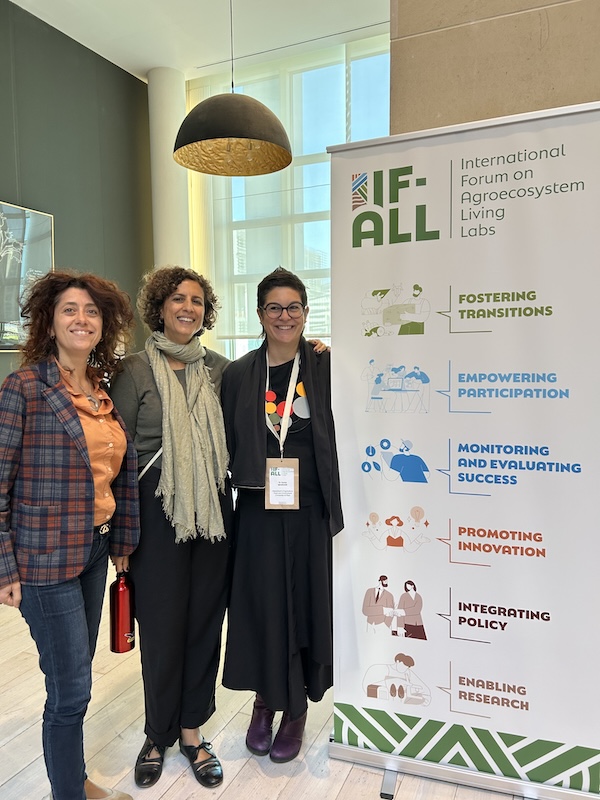
The International Forum on Agroecosystem Living Labs (IF-ALL 2025) took place in Bordeaux from 15 to 17 October 2025, co-organized by INRAE (French National Research Institute for Agriculture, Food and Environment) and Agriculture and Agri-Food Canada (AAFC), with the support of the Nouvelle-Aquitaine Region and several international partners.
The event aimed to take stock of the current state of the Living Lab approach, which has become increasingly central to research projects seeking to foster inclusive, participatory, and transformative innovation processes. Six thematic groups explored key issues such as the role of Living Labs in agroecological transitions, multi-actor participation, monitoring and evaluation, governance, policy, and research, while also addressing cross-cutting themes such as gender and learning.
The first day featured three field visits to Living Labs in the Nouvelle-Aquitaine region:
- Bacchus Living Lab (sustainable viticulture and vineyard landscapes),
- Bocage Forestier (biodiversity and forest resilience),
- Sécurité Sociale de l’Alimentation (the right to sustainable and quality food).
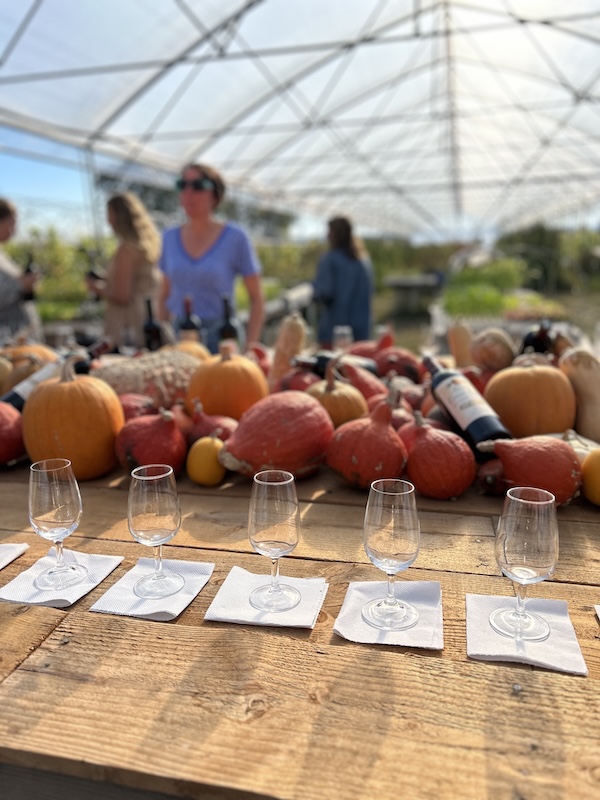
Some PAGE participants joint the technical tour at the BACCHUS Living Lab, a research site designed to support the agroecological transition of vineyard-based landscapes.
Over the following two days, case studies from across five continents illustrated the diversity of contexts and approaches — from Living Labs focusing on soil biodiversity management across the globe, a key topic of the European Agroecology Partnership, to examples from local food systems. One notable case, presented from Clermont-Ferrand, described a participatory reorganization of the local school catering system that promoted the use of locally produced Ferrandaise beef, achieving significant environmental and economic impacts.
Participants included researchers with highly diverse backgrounds, spanning both natural and social sciences, many of whom have moved between these fields throughout their careers. Discussions highlighted that, while no universal model exists and adaptability to each context remains essential, professionalizing Living Labs requires strong expertise in long-term multi-actor process management, as well as the growing involvement of anthropologists and designers — professionals skilled in facilitating co-design and collective learning dynamics.
The PAGE team – University of Pisa, drawing on its long-standing experience in coordinating and supporting Living Labs within Horizon projects, contributed actively to the Forum with three presentations across different thematic sessions:
- Dalia Mattioni presented “From Living Labs to territorial networks: fostering diversity, recruitment, and stakeholder engagement” (co-authored with F. Galli, L. Colombo, D. Desclaux, A. M. Loconto, S. Massari, Y. Chiffoleau) within the DivINFOOD (Horizon Europe) project, discussing strategies to support the long term transformation of Living Labs into stable Value-Based Territorial Networks in order to enhance their sustainability in time.
- Sonia Massari presented “Empowering Early Career Researchers: Mentorship, Co-Creation, and Design in Living Labs” (co-authored with A. Ferrara, S. Arcuri, F. Galli, F. Arfini, M. Maccari, A. Cavicchi) as part of the national ONFOODS project, focusing on the importance of creativity and training for people working in Living Labs. She shared the experience of our Department and its collaboration with the different Tenuta Labs, described as transformative learning places where innovative ideas can grow through dedicated mentorship programs for Early Career Researcher
- Mariagiulia Mariani contributed to the Monitoring and Evaluating Success session with “Assessing and enhancing the transformative potential of agroecosystem Living Labs: a social innovation perspective” (co-authored by L. Ortolani and C. Giua), advocating for the integration of social innovation assessment throughout the Living Lab lifecycle, for instance through the Social Innovation Self-Assessment Tool (SIAT) developed within the InnOBreed project.
- Goldel Bastian Christoph presented a poster illustrating part of the ONFOODs project, curated by the PAGE Research Group. The poster explores how Living Labs are used in European research to address environmental challenges, highlighting methods, impacts, and opportunities for more sustainable food systems.
The Forum concluded with a high-level panel dedicated to the science–society–policy interface, which underscored how Living Labs can serve as powerful boundary spaces that mediate between local practices and global policy agendas.
